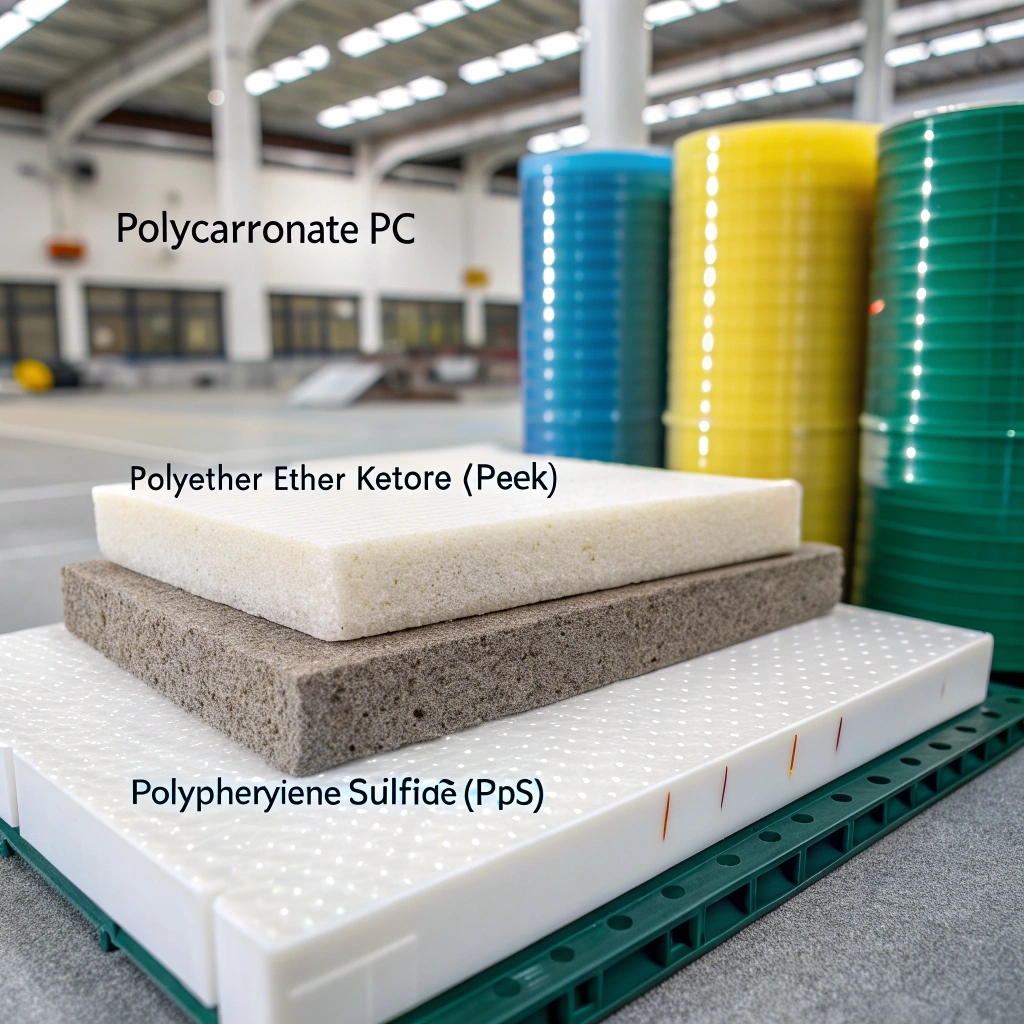
Injection molded plastics often fail under extreme stress, leading to broken parts, product recalls, and financial losses. Choosing the right high-strength plastic ensures durability and reliability.
The strongest injection molded plastics, such as polycarbonate (PC), PEEK, and PPS, offer exceptional impact resistance, heat tolerance, and chemical stability. These materials outperform standard plastics in toughness, longevity, and performance, making them ideal for demanding industrial, automotive, and electronic applications.
Understanding which plastic meets your product’s needs is key to achieving strength, safety, and performance
Polycarbonate (PC)
Polycarbonate is widely regarded as one of the strongest injection molded plastics. It offers outstanding impact resistance, even at low temperatures, making it suitable for protective equipment, automotive components, and electronic housings. PC can withstand repeated stress without cracking, and its transparency makes it ideal for applications requiring visual clarity. Additionally, it performs well under heat, maintaining structural integrity in challenging conditions.
Polyether Ether Ketone (PEEK)
PEEK is a high-performance engineering plastic known for its exceptional mechanical strength, chemical resistance, and thermal stability. Injection molded PEEK components can operate at temperatures up to 250°C (482°F) without deforming, making it ideal for aerospace, medical, and industrial applications. Its strength-to-weight ratio surpasses most common plastics, and it maintains performance under continuous load and harsh chemical environments.
Polyphenylene Sulfide (PPS)
PPS is another high-strength injection molded plastic with excellent dimensional stability, chemical resistance, and heat tolerance. Its crystalline structure provides rigidity and resistance to creep, making it suitable for automotive, electronics, and industrial parts exposed to high temperatures. PPS can endure repeated thermal cycles while retaining its mechanical properties, which is crucial for long-lasting components.
Nylon (Polyamide, PA)
Nylon, or polyamide, is a versatile and durable plastic often used for injection molding. It offers high tensile strength, good wear resistance, and excellent chemical resistance. Reinforced versions, such as glass-filled nylon, significantly increase stiffness and strength, making it ideal for gears, fasteners, and mechanical components that face constant stress. Its moisture absorption properties can slightly affect dimensions, so proper design considerations are necessary.
Comparing High-Strength Plastics
When choosing the strongest injection molded plastic, consider the application requirements:
- Impact resistance: Polycarbonate excels.
- High-temperature performance: PEEK and PPS are superior.
- Chemical resistance: PEEK, PPS, and reinforced nylon perform best.
- Wear and fatigue resistance: Reinforced nylon is highly effective.
Cost and processing considerations also matter. While PEEK offers unmatched strength, it is expensive and requires specialized processing. Polycarbonate and reinforced nylon provide a balance between cost, strength, and manufacturability.
Applications of High-Strength Injection Molded Plastics
These high-performance plastics are used in various demanding applications:
- Automotive: Engine covers, brackets, and structural components.
- Electronics: Housings, connectors, and insulating parts.
- Medical devices: Surgical instruments and high-sterility components.
- Aerospace: Lightweight yet strong components for extreme environments.
Selecting the correct plastic ensures products can endure mechanical stress, thermal cycles, and chemical exposure without failure.
Conclusion
The strongest injection molded plastics—PC, PEEK, PPS, and reinforced nylon—combine strength, durability, and chemical resistance for reliable, long-lasting parts.